
English
Reading Intent Statement
Reading lies at the heart of the curriculum at St Barnabas. We are dedicated to enabling our pupils to become lifelong readers and we believe that reading is the key to academic success.
We aim to provide children with a literacy-rich environment, high quality texts and inspiring learning opportunities, which will help them to: gain a life-long enjoyment of reading and books, read accurately, fluently and with understanding, apply a knowledge of structured synthetic phonics to decode unfamiliar words with increasing accuracy and speed, be able to read with expression, clarity and confidence, discuss, learn and apply new vocabulary, read and respond to a wide range of quality fiction and non-fiction texts and be inspired by the ‘power of story’ which will ignite the writing.
This strategy aims to ensure that there is coherence, continuity and progression within our teaching of reading throughout the school.
Teaching the Reading Curriculum
Preschool
Preschool use the Rocket Phonics scheme using materials provided by Rising Stars. This is taught every Morning for 10 minutes altogether straight after welcome, as well as implemented in their continuous provision. During the sessions children will read a interactive big book, learn a ‘ditty’ rhyme and look at the flashcard for their new sound of the week. Once the children have been taught a new sound during that week, activities will be put out in the mark making area for children to begin to form the letters or create marks/shapes that are similar to the sound that has been taught.
Reception
Phonics is taught every day for 30 minutes from the start of the academic year. The Rocket Phonics programme consists of whole class teaching followed by engagement in individual pupil booklets. This is to ensure that children are reaching their full potential to practise and apply the phonics skills taught and that appropriate support/challenge is given by an adult.
Within the Rocket Phonics scheme each week consists of the same structure:
Day 1 - Blending focus of a new grapheme
Day 2 - Segmenting focus of the grapheme from day 1
Day 3 - Blending focus of a new grapheme
Day 4 - Segmenting focus of the grapheme from day 3
Day 5 - Flexible Day - consolidation, focus on common exception words/tricky words, assessment, enrichment.
A wide range of activities and games are used to help support the children during the week within continuous provision linking to the phonics lessons that have been taught that day/week.
The aim is for children to read and recognise all sounds from pink, red and yellow colour band Rocket Phonics books and the first 7 sounds from the blue rocket phonics books.
Year 1
Phonics is taught every day for 30 minutes from the start of the academic year. The Rocket Phonics programme is the sole programme used. Teaching consists of whole class engagement followed by practice in Pupil Booklets. This is to ensure that children are reaching their full potential and that appropriate support is given: some children are supported by an adult who can challenge/ support where appropriate; others may be working independently to consolidate their learning.
Within the Rocket Phonics scheme each week consists of the same structure:
Day 1 - Blending focus of a new grapheme
Day 2 - Segmenting focus of the grapheme from day 1
Day 3 - Blending focus of a new grapheme
Day 4 - Segmenting focus of the grapheme from day 3
Day 5 - Flexible Day - consolidation, focus on common exception words/tricky words, assessment, enrichment.
A wide range of activities and games are used to help support the children during phonics interventions.
NB: Phonics screening takes place in June - further details can be found below.
Year 2
Phonics is taught every day for 25 minutes from the start of the academic year. The Rocket Phonics Next Steps programme is the sole programme used. Teaching consists of whole class engagement followed by practice in Pupil Booklets. This is to ensure that children are reaching their full potential and that appropriate support is given: some children are supported by an adult who can challenge/ support where appropriate; others may be working independently to consolidate their learning.
The structure of the week for year 2 is slightly different than the earlier teaching in the Rocket Phonics programme. Rocket Phonics Next Steps revisits letter-sounds correspondences that are taught in Year 1 but introduces new spelling content. A piece of learning is investigated and built upon over several days. The fifth day is planned as a cursive handwriting focus or can be used for consolidation, assessment or enrichment activities. A wide range of activities and games are used to help support the children during their phonics lessons.
NB: Any children who did not pass the phonics screening test in Year 1 will retake in June also - further details can be found below.
Phonics and Early Reading
Early reading is taught through a systematic synthetic phonics programme ‘Rocket Phonics’. This programme is used from Reception through to year 2, but also for pupils across years 3 and 4 who still need phonics teaching. Pupils in years 5 and 6 who still need phonics are taught using the Fresh Start strand within the Read Write Inc programme. Rocket Phonics is a fully resourced, systematic synthetic phonics programme. It provides a combination of digital and printed resources, and a fully matched series of decodable reading books. Big Books are at the heart of the programme; they consist of language-rich stories to teach all the target letter-sounds in context. These books are designed for use on an IWB at the front of the class. Flashcards are provided on cards and electronically to use during each lesson as an introduction to a new sound or recapping previous sounds. Children will complete a pupil practise book for each sound/tricky word that is taught. They will be able to show what they have learnt during the input of the lesson through the big books and flashcards.
Teaching high quality phonics lessons and fidelity to the scheme enables children to learn the sounds they need to read and then to use and apply them. Pupils begin by learning individual letter sounds, then how to blend these sounds into words and then begin to read CVC words using the skills of segmenting and blending taught in the daily phonics lessons. When they are ready to progress, pupils will be introduced to reading books, which use the sounds they have been taught and allow them to apply their phonic knowledge and enjoy reading a book. As their phonic knowledge increases, so does the complexity of the books they read. The books used in Rocket Phonics are fully aligned to the programme, but children should only be reading books with letter-sounds they have already been taught. This means children can continue to practise letter-sounds taught earlier in the programme and be confident to read the book band they are on.
Phonics lessons
Phonics is taught everyday in EYFS, Year 1 and Year 2 following the Rocket Phonics programme. Pupils in Year 3 and 4 who didn’t pass the Phonics Screening in Year 2 will have phonics interventions to support them further. Phonics lessons are kept fast paced and usually last no longer than 20-30 minutes: this is to ensure that all pupils are fully engaged and enjoying their phonics learning.
Phonics lessons teach and practise new sounds, revisit and review previously taught sounds and then taught how to segment and blend words to then apply this into their reading and writing across all areas of the curriculum. Common exception and tricky words are also incorporated into phonics lessons so that children can read and write these correctly.
Reading lessons
In EYFS and Year 1 children are allocated reading books according to their Phonics ability and in line with the Rocket Phonics programme scheme.
Each class will have a reading file where reading records are maintained and current reading levels recorded.
These are the book bands and progression from Reception through to the end of Year 2.
In Preschool, children have daily story times together where they will read stories as a whole class and talk about the book they are reading. Preschool also have a reading corner where children will have access to books throughout the day and access to a book library in outdoor provision.
In Reception, there is a story time every day before lunch. We also do a whole class reading session after lunch for 30 minutes. This is where we will read a digital copy of a book from the online library of Reading Planet Rocket Phonics. While reading this book we will discuss meanings of new words and vocabulary and throughout will use our comprehension skills to answer questions about the book electronically with the questions provided with the books. As we progress through the year, we will also use our phonics skills to segment and blend words so that children can read sections of the book to the class. In Reception we also have our daily novel at the end of the day, this means the children are exposed to different genres of books over the year.
St Barnabas has a clear long-term plan for English. The reading section is underpinned by progression in reading documents and the National Curriculum. Teachers use this document to plan medium term units for English and for whole class reading lessons.
In line with the Department for Education Reading Framework (2023), we recognise that fluency is the essential bridge between accurate decoding and secure comprehension. We prioritise the development of accuracy, automaticity and prosody through regular opportunities for pupils to re-read carefully matched texts, ensuring that cognitive capacity is released for meaning-making. Our approach reflects the evidence base highlighted by the Education Endowment Foundation, which identifies reading comprehension strategies as having a consistently high impact when explicitly taught. At St Barnabas, comprehension is developed through structured teacher modelling, high-quality questioning, scaffolded practice and purposeful discussion, rather than through repetitive test practice. Our reading lessons are therefore designed to integrate fluency, vocabulary development and comprehension in a coherent and systematic way, enabling pupils to become confident, thoughtful and independent readers. At St. Barnabas, we use One Education’s Reading Gems to ensure we teach the skills needed to decode, understand, and enjoy books. Each week a reading skill is explicitly taught in each key stage. Whilst this skill is the main focus of the week, teachers refer to other skills throughout the reading sessions. During these reading sessions, children learn specific reading comprehension strategies. See below:
Quality age-appropriate texts have been selected by the class teachers for the reading lessons - these are age-appropriate books and on one day a week, children are exposed to poetry off by heart. Modelling of skills, the pre-teaching or post-teaching (key stage dependent) of vocabulary and high-quality questioning are all non-negotiables for reading lessons. Children also ‘read for pleasure’ in their reading sessions and will be listened to reading regularly or in a group (key stage dependent). As part of the Reading Gems lesson, children are introduced to rich vocabulary (Tier 2/3 words) in ‘Word Blast’.
Further details about each key stage can be found below:
Key Stage One - Reading sessions
Children explore a book a week. Day 1 is spent looking at background knowledge. Day 2 is all about vocabulary alongside reading the text. Day 3 looks more closely at the reading skill of the week with the class. Day 4 is when children apply the reading skill of the week and Day 5 is a Treasure Chest when the children explore mixed reading skills.
KS2/ 3 Reading Sessions
From Monday to Wednesday, KS2 children explore one of the reading gems skills. On Wednesday, they complete an Exit Ticket to apply this skill.
Every Thursday, children are given the chance to apply their reading skills within a Treasure Chest lesson. This helps to develop their confidence and independence in applying different reading skills in a range of ways. The same text is used to help children to gain a more in-depth understanding of themes and plots within texts whilst keeping the cognitive load of decoding lower.
Non-Fiction Friday and Poetry
At St Barnabas, we recognise that national curriculum design has often prioritised fiction at the expense of non-fiction. However, non-fiction is vibrant, intellectually demanding and essential to pupils’ academic success and life beyond school. In line with the Department for Education Reading Framework (2023), we ensure pupils are systematically exposed to a broad range of high-quality texts, including both literary and non-fiction forms, so that they develop wide knowledge and secure comprehension.
WRITING
Writing Intent Statement
Writing is a central part of the school’s curriculum. We believe that if we equip the children with the correct writing tools, they will be able to use them effectively within a literate world. The children at St. Barnabas have many opportunities to write for different purposes and use quality reading texts in English lessons to model examples of good writing. We show children what a good one looks like linked to our text where appropriate and provide scaffolds to support writing and gradually remove these as confidence grows. We want the children to grow into confident writers who feel inspired to write in all areas of the curriculum. We provide children with exciting, purposeful and inspiring reasons to write and we aim to create passion for writing and create an environment where children can identify themselves as writers. We have high expectations of the finished writing product, and our children work hard to maintain high standards, taking pride in their presentation.
This strategy aims to ensure that there is coherence, continuity and progression within the teaching of writing throughout school and utilises the recommendations of the DfE Writing Framework 2025.
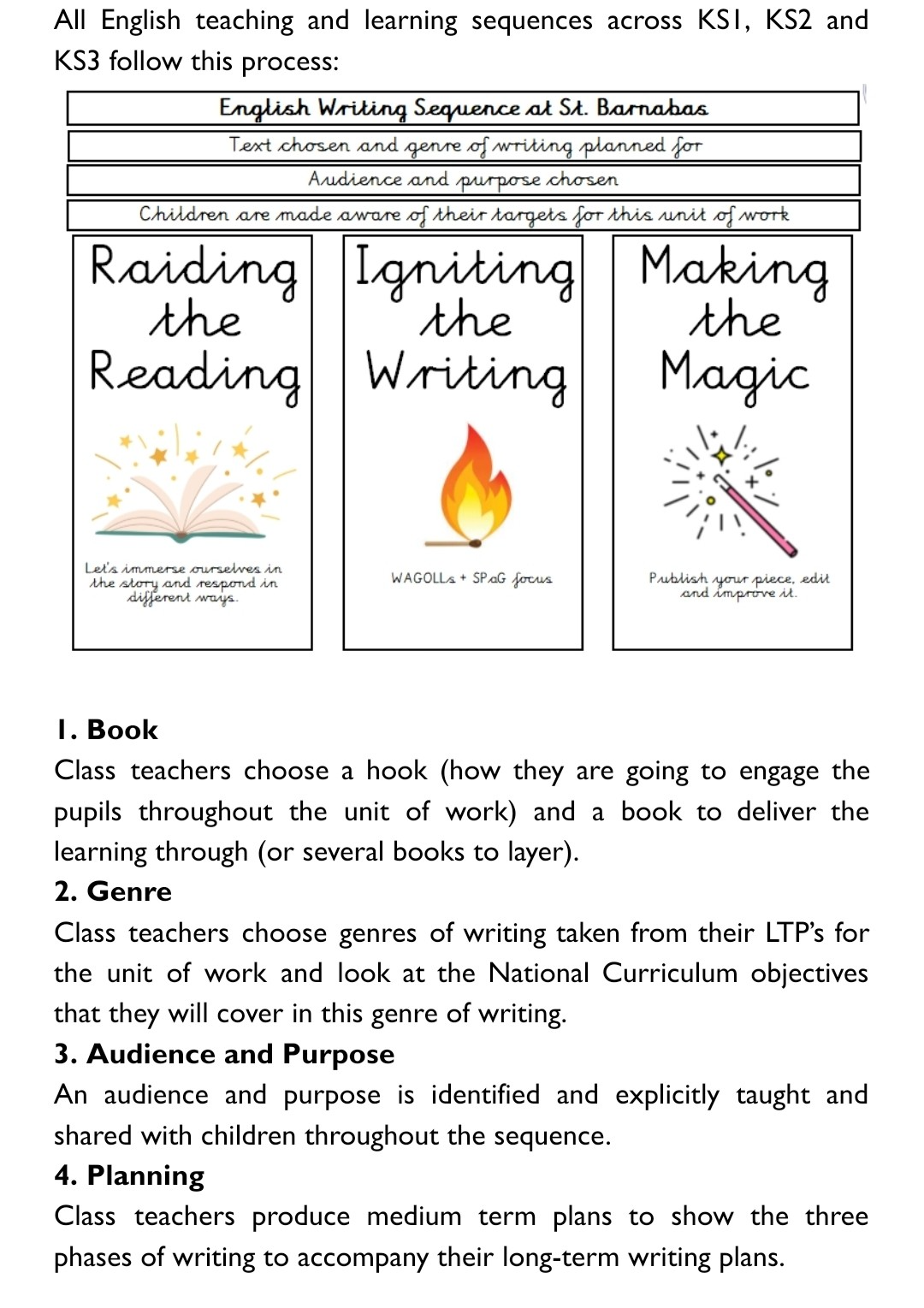
Raiding the Reading
The purpose of this stage is to capture the pupil’s interest and help them get to know the text well. This is through both 'reading as a reader' - exploring and sharing personal responses to what they read - and through 'reading as a writer' - recognising and investigating the features the writer uses to engage and manipulate the reader. Teachers will pre-teach unfamiliar vocabulary.
Igniting the Writing
The purpose of this stage is to ignite ideas for writing by exploring specific text-types and identifying features looking at vocabulary, grammar and sentence work.
In teaching sequences, this section tends to include many of the following: teacher shares WAGOLL with children, generating ideas to write about and one idea chosen; a shared activity to generate content for the chosen content; recording key ideas alongside the structure of the text; telling and talking to generate the text; story mapping the text where necessary. Shared writing supports: modelling writing the text, usually in sections applying learning from the first phase; children writing their own version of the text using the class idea, including ‘Innovation’ (Talk for Writing).
Making the Magic
The purpose of this stage is to get pupils writing independently. Pupils use their work from the Igniting the Writing phase to help them to write their final piece. Before pupils begin writing, the objective and writing skills needed to achieve the objective are clearly displayed and discussed. How to be successful should have been continuously referred to so that children know the steps to success, modelled by the teacher in the Igniting the Writing stage. Teachers mark this written piece according to the Marking and Feedback policy/as a whole class feedback sheet. Children are then praised for what they have achieved and are also given specific targets to work on in the next genre of writing.
As part of the writing sequence, a lesson will be planned into a sequence so that after the whole class feedback has been shared with a class, teachers will have 1:1/small group writing conferences. Children will be given a task linked to the text whilst they are waiting for their feedback. In these conferences, teachers will share with children what their individual targets are and give them the opportunity in purple polishing pen to show that in editing. Children’s new targets going forward will be recorded on a post it note or a piece of paper that children can refer to quickly and easily when writing independently.
Oracy in the Curriculum
Oracy runs across the full teaching sequence and doesn’t just sit within a single lesson. During ‘Raiding the Reading’, pupils engage in book talk, prediction and vocabulary discussion. In the ‘Igniting the Writing’ phase, pupils rehearse and manipulate sentences orally. In planning and drafting, they talk through content, structure and individual sentences before writing. In editing, they evaluate and refine ideas aloud. This mirrors the Writing Framework’s emphasis on oral rehearsal as a precursor to composition and ensures that talk strengthens every stage of the writing process. Teachers are explicit about the type and purpose of talk pupils are engaging in. Units should balance exploratory talk (thinking aloud), rehearsal talk (trying out sentences), presentational talk (sharing ideas clearly) and discussion or debate (justifying viewpoints). Teachers model high-quality spoken language and think aloud when composing and modelling.
Pencil grip
The Writing Framework 2025 states that from Reception children should be ‘learning how to hold and control a pencil and the correct position for writing and that pupils need to be taught explicitly how to hold a pencil’. Across the school children are reminded of how to hold their pencil in the correct tripod grip. In preschool and reception children have been given a rhyme to help them remember to hold their pencil in their correct way. “Crocodile snaps and flip him on his back”. From year 1 to year 7 children use a song to encourage and remind them how they should be holding their pencil.
Pencil Grip song
Thumb and poter finger,
Thumb and pointer finger,
Pinch the pencil,
Pinch the pencil,
Middle finger holds it up,
Middle finger holds it up,
The other two curl,
The other two curl.
These phrases and songs are embedded into handwriting and English lessons so that children are reminded of the correct pencil grip at all times. Children are also provided with pencil grips to go on their pencils if they need extra support with holding their pencil in the correct way.